
Artificial intelligence is no longer just a futuristic concept. In 2026, it’s becoming the operating system behind how millions of people work, communicate, create content, manage schedules, and even run businesses.
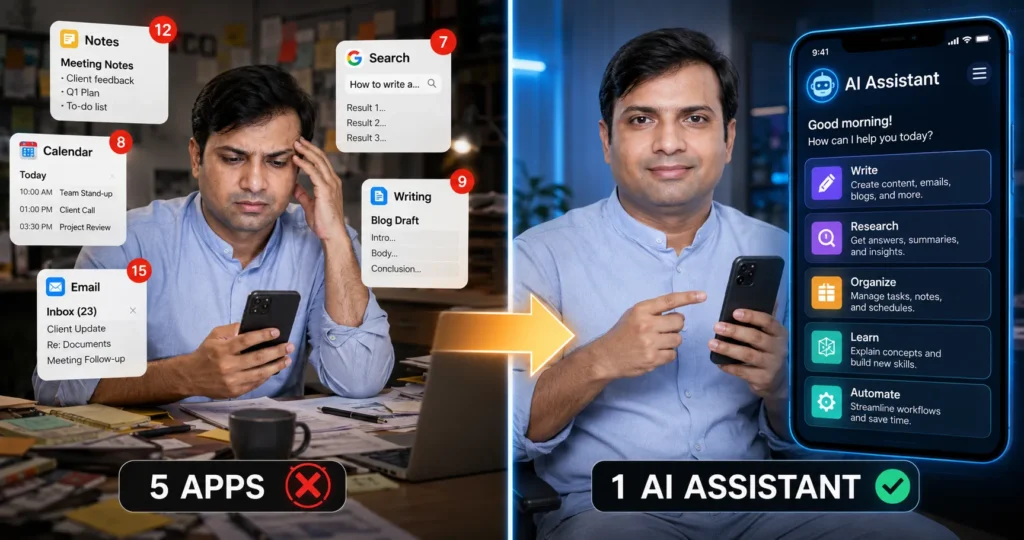
But here’s the surprising part: most smartphone users are still downloading separate apps for note-taking, writing, scheduling, research, and productivity—even though a single AI-powered solution can now handle all of them.
If you’ve ever felt overwhelmed by app overload, constant notifications, subscription fatigue, or jumping between tools just to complete a simple task, you’re not alone.
The rise of the best AI assistant app category is changing that reality.
Today’s advanced AI assistants are becoming digital companions capable of replacing multiple applications while saving time, reducing costs, and improving productivity. Whether you’re a student, entrepreneur, content creator, freelancer, or business owner, one AI tool may be doing the work of five traditional apps.
Let’s explore why this shift is happening and why so many people are missing one of the biggest productivity trends of 2026.
Table of Contents
Read also: Why is my WiFi so slow
Why AI Assistants Are Replacing Traditional Apps
For years, smartphones followed a simple model:
- One app for notes
- One app for scheduling
- One app for email
- One app for research
- One app for content creation
The problem?
Every app creates another subscription, another login, another notification, and another workflow.
Modern AI systems are changing that equation.
Instead of switching between multiple tools, users can now interact with a single conversational interface that understands context and performs multiple tasks simultaneously.
This trend is accelerating as companies invest heavily in AI infrastructure, cloud computing platforms, enterprise software solutions, and automation software.
The result is a new generation of AI-powered mobile assistant applications that function more like digital employees than traditional apps.
The Five Jobs One AI Tool Can Handle
1. Personal Productivity Manager
The most obvious use case is task management.
A modern AI assistant can:
- Create to-do lists
- Set reminders
- Prioritize tasks
- Build schedules
- Track deadlines
- Organize projects
Instead of juggling multiple productivity tools, users can simply ask the assistant what needs attention today.
This is why many professionals now view AI as the ultimate AI app for productivity.
2. Content Writer and Research Assistant
Content creation has become one of AI’s strongest capabilities.
An AI assistant can:
- Draft blog posts
- Generate social media captions
- Summarize articles
- Create email campaigns
- Research topics
- Generate video scripts
For marketers and creators, this replaces multiple writing and research applications while accelerating production workflows.
Businesses leveraging AI tools for business automation are seeing substantial productivity gains across content departments.
3. Smart Search Engine
Traditional search often requires opening dozens of tabs.
AI assistants simplify the process by:
- Summarizing information
- Comparing sources
- Explaining technical concepts
- Providing actionable recommendations
Rather than searching, reading, and interpreting manually, users receive contextual answers instantly.
This is particularly useful for professionals researching cloud computing platforms, cybersecurity solutions, web hosting services, VPN services, or SaaS tools for business growth.
4. Virtual Executive Assistant
One of the fastest-growing applications of AI is executive support.
AI assistants can:
- Draft meeting agendas
- Summarize discussions
- Prepare reports
- Schedule appointments
- Create follow-up emails
Entrepreneurs and remote workers increasingly rely on these capabilities to streamline daily operations.
What once required dedicated administrative software can now happen inside a single assistant.
5. Learning and Coaching Companion
Modern AI assistants are becoming personalized educators.
They can:
- Explain difficult topics
- Create study plans
- Teach coding concepts
- Generate quizzes
- Offer business guidance
Students and professionals use these systems as always-available mentors.
This represents one of the most transformative examples of smart AI assistant features available today.
The One AI Tool Everyone Is Missing: ChatGPT
While dozens of AI applications claim to boost productivity, one platform has quietly evolved into an all-in-one digital assistant capable of replacing multiple everyday apps: ChatGPT from OpenAI.
Originally launched as a conversational AI tool, ChatGPT has expanded into a powerful ecosystem that combines writing assistance, research capabilities, productivity management, learning support, and workflow automation.
For many users, this means fewer app subscriptions, less screen clutter, and a more streamlined digital experience.
How ChatGPT Replaces Five Different Apps
| Traditional App Category | What ChatGPT Can Do |
|---|---|
| Notes & Productivity Apps | Create to-do lists, meeting notes, project plans, reminders |
| Writing Apps | Draft articles, emails, social posts, reports, and scripts |
| Search Engines | Summarize information and answer complex questions |
| Scheduling Assistants | Build schedules, agendas, and workflow plans |
| Learning Platforms | Explain concepts, create study plans, and provide tutoring |
This combination makes ChatGPT one of the most complete AI-powered mobile assistant solutions currently available.
A Real-World Example
Imagine you’re launching a small online business.
Instead of opening five separate apps, ChatGPT can help you:
- Create a business plan
- Generate marketing content
- Build an SEO strategy
- Draft customer emails
- Research competitors
- Organize daily tasks
- Learn new business skills
What previously required several software subscriptions can often be handled through a single AI interface.
Why ChatGPT Stands Out in 2026
Several factors have contributed to ChatGPT’s popularity among professionals, creators, entrepreneurs, and students:
Unified Experience
Users no longer need separate apps for writing, brainstorming, planning, and research.
Advanced AI Capabilities
Modern versions can analyze documents, understand images, assist with coding, and automate complex workflows.
Cross-Device Accessibility
ChatGPT works across smartphones, tablets, and desktop devices, making it a true companion for modern productivity.
Business and Enterprise Adoption
Organizations increasingly use AI tools like ChatGPT alongside cloud computing platforms, cybersecurity solutions, SaaS tools, and enterprise software systems to improve operational efficiency.
Where to Try ChatGPT
You can explore the platform directly through the official OpenAI website: ChatGPT
Or learn more about the technology behind it at: OpenAI
As AI adoption accelerates in 2026, ChatGPT represents one of the clearest examples of how a single intelligent assistant can successfully replace apps with AI while improving productivity, learning, and digital workflows.
AI App for Productivity: Real-World Use Cases
Let’s look at practical examples.
Freelancer
Before AI:
- Notes app
- Writing app
- Calendar app
- Research app
- Email assistant
After AI:
- One intelligent assistant handling all workflows
Content Creator
Before AI:
- Keyword research tools
- Script writing software
- Idea generators
- Content planners
After AI:
- Centralized creation process
Small Business Owner
Before AI:
- Multiple SaaS subscriptions
- Manual scheduling
- Customer support tools
After AI:
- Automated workflows
- Faster communication
- Improved operational efficiency
Traditional Apps vs AI Assistant Apps
| Feature | Traditional Apps | AI Assistant Apps |
|---|---|---|
| Single Purpose | Yes | No |
| Context Awareness | Limited | Advanced |
| Workflow Automation | Minimal | High |
| Learning Capability | Low | Continuous |
| Multi-task Support | No | Yes |
| Productivity Impact | Moderate | Significant |
| Personalization | Basic | Advanced |
The shift toward AI-first workflows is becoming increasingly visible across both consumer and enterprise markets.
How AI-Powered Mobile Assistants Save Time
The biggest benefit isn’t convenience.
It’s time.
Studies across workplace productivity environments consistently show that context switching reduces efficiency and increases cognitive fatigue.
When users move between:
- Messaging apps
- Productivity apps
- Research tools
- Writing platforms
they lose focus.
An AI-powered mobile assistant reduces these interruptions by becoming a central hub for information and action.
The result is:
- Faster decision-making
- Improved focus
- Better task completion
- Reduced digital clutter
The Future of AI Tools for Smartphones
The next generation of AI tools for smartphones will go far beyond chat interfaces.
Expected developments include:
Predictive Assistance
AI will anticipate needs before users ask.
Device-Wide Integration
Assistants will interact seamlessly across apps and devices.
Enhanced Privacy Controls
Data privacy tools and cybersecurity protections will become core features.
Business Automation
Routine workflows will become increasingly autonomous.
Monetization Support
Entrepreneurs will use AI to build online business monetization systems, generate marketing campaigns, and automate customer engagement.
This is one reason technology analysts believe AI assistants will become the most important software category of the decade.
Data Insights: The App Consolidation Trend
What Users Want in 2026
| User Need | Importance |
| Time Savings | Very High |
| Automation | Very High |
| Simplicity | High |
| Cost Reduction | High |
| Privacy Controls | High |
| Personalized Assistance | Very High |
A growing number of consumers now prioritize platforms that consolidate tasks rather than adding new tools to their digital stack.
This trend aligns with broader movements in automation software, cloud services, and enterprise productivity platforms.
Expert Tips for Maximum Productivity
Use AI as a Workflow Hub
Don’t treat your assistant like a search engine.
Use it as a central operating system for daily work.
Create Repeatable Prompts
Save frequently used instructions for recurring tasks.
Combine Research and Execution
Ask AI not only for information but also for action plans.
Review Outputs
AI accelerates work, but human judgment remains essential.
Protect Sensitive Data
Follow cybersecurity best practices and avoid sharing confidential information unnecessarily.
Common Mistakes Users Make
Using AI Only for Simple Questions
Many users never explore advanced capabilities.
Expecting Perfect Results
AI is a productivity multiplier, not a replacement for expertise.
Ignoring Privacy Settings
Always review data privacy options.
Keeping Old Workflows
The biggest gains come when users redesign processes around AI.
App Hoarding
If one AI solution can perform several functions, unnecessary apps may create friction rather than value.
Final Thoughts
The smartphone app economy is entering a new phase.
For years, users added more apps to solve more problems. Now the opposite is happening.
The most powerful trend of 2026 isn’t another social network or productivity platform. It’s the emergence of intelligent assistants capable of performing multiple jobs from a single interface.
The best AI assistant app isn’t simply another tool competing for attention. It’s becoming the digital layer that connects work, learning, communication, automation, and creativity.
As AI continues evolving, the question may no longer be which apps you use.
The question will be how many apps your AI assistant can replace.
FAQs
What is the best AI assistant app in 2026?
The best AI assistant app depends on your needs, but leading platforms now combine productivity, writing, research, scheduling, and automation features into one experience.
Can AI replace productivity apps?
Yes. Modern AI assistants can manage tasks, reminders, schedules, note-taking, and workflow planning, reducing the need for multiple productivity applications.
Are AI-powered mobile assistants safe to use?
Most major AI platforms include privacy controls and security features, but users should review settings and avoid sharing sensitive information unnecessarily.
How do AI tools for smartphones improve productivity?
They reduce app switching, automate repetitive tasks, provide instant research support, and streamline communication workflows.
Can AI help with online business monetization?
Yes. AI can assist with content creation, digital marketing strategies, customer communication, SEO planning, and business automation.
Do AI assistants work for students?
Absolutely. Students use AI for learning, research, summarization, study plans, and exam preparation.
Can one AI tool really replace five apps?
For many users, yes. AI assistants can combine writing, scheduling, research, note-taking, and task management into a single platform.
Is AI useful for small businesses?
AI can automate workflows, improve productivity, support marketing efforts, and reduce software complexity for growing businesses.

Israr Ahmed Technology educator and IT professional specializing in networking, cybersecurity, software solutions, and digital systems. Founder of DriveInTech, delivering practical tutorials, AI tools, SEO strategies, and real-world digital solutions.